
Before the launch, before construction, before any photograph exists, 3D renders for social media are the tool that creates demand when there is still nothing to show.
There is a window of opportunity in property marketing that most developers let slip by.
It is not the launch. It is not the performance campaign. It is not the sales opening event.
It is the period before all of that, when the project does not yet physically exist, when there are no photographs, when there is no construction to show.
That is exactly when 3D has its greatest power. And that is exactly when most people decide to wait.
This article is about not waiting. It is about using 3D renders on social media in a strategic, progressive and deliberate way, so that you reach launch day with an audience that already wants the project before they have seen it.
The mistake almost everyone makes
The usual sequence is this: the project is developed, the renders are produced, the website is finished, and only then, when everything is “done”, does the communication begin.
This model has a fundamental problem: it treats the launch as the start of the conversation.
It is not. It is the point where the conversation should be warm enough to convert.
When you reach launch day without having built an audience, created anticipation or generated desire, you are presenting a project to strangers. And strangers do not buy at the first meeting.
The alternative is to reach the launch with people who already know the project, already want it, and are just waiting for a reason to go ahead.
That difference is not created with a bigger media budget. It is created with a smart content strategy that begins weeks or months before the launch.
Why 3D is the perfect tool for the job
Before the building exists, the renders exist. And renders, when well produced, have a unique ability: to make what does not exist look real and desirable.
No other marketing tool can do that as effectively.
A floor plan does not move anyone. A model does not sell. A descriptive text does not create desire.
A 3D image showing afternoon light coming through the window of a living room with marble and wood, a bowl of fruit on the island and books stacked on the shelf: that image makes someone stop scrolling, save the post and send it to their partner with the message: “look at this.”
That moment, that message sent, is the beginning of a sale. And it happened weeks before any estate agent had made a single call.
The progressive reveal strategy with 3D renders on social media
The biggest mistake on social media is not posting too much. It is posting everything at once.
When you release all the renders at the same time, in an album, a gallery or a ten-image post, you are giving everything away at once. There is no reason to come back. There is no anticipation. There is no conversation.
The strategy that works is different: the progressive reveal.
Instead of showing the project in one go, you reveal it in layers, over weeks, with intent, with a sequence and with a narrative that keeps building.
Each post is a chapter. Each chapter increases desire. And accumulated desire is what turns the launch into an event.
The five layers of the progressive reveal
Layer 1. The teaser: create curiosity without revealing
Start before you have final renders. You can use a material detail: the veining of the marble chosen for the kitchen, the texture of the wooden cabinets, the tone of the flooring.
A photograph of a material sample with a simple caption: “Something is being built. Coming soon.”
It is not about what you show. It is about what you do not show. Curiosity is a more powerful motivator than information.
In this layer, the goal is not to sell. It is to create the feeling that something is happening, and that it is worth following.
Layer 2. The first render: the space that sells the most emotion
When the first render is ready, choose carefully which one to post first.
Do not choose the most complete. Choose the most emotional.
Which space most quickly creates the feeling of “I want to be here”? For most residential projects it is the living room with natural light, or the kitchen with an island and details of everyday life. For luxury projects, it might be the main suite or the balcony with a view.
This first render should be vertical, optimised for feed and stories. With careful styling: elements of real life, warm lighting, a depth of field that creates intimacy.
The caption does not talk about prices. It does not talk about unit types. It sets a scene: “A Sunday morning. Light coming through the window. The day not yet begun.”
The goal of this layer is to stop the scroll and get someone to save the post.
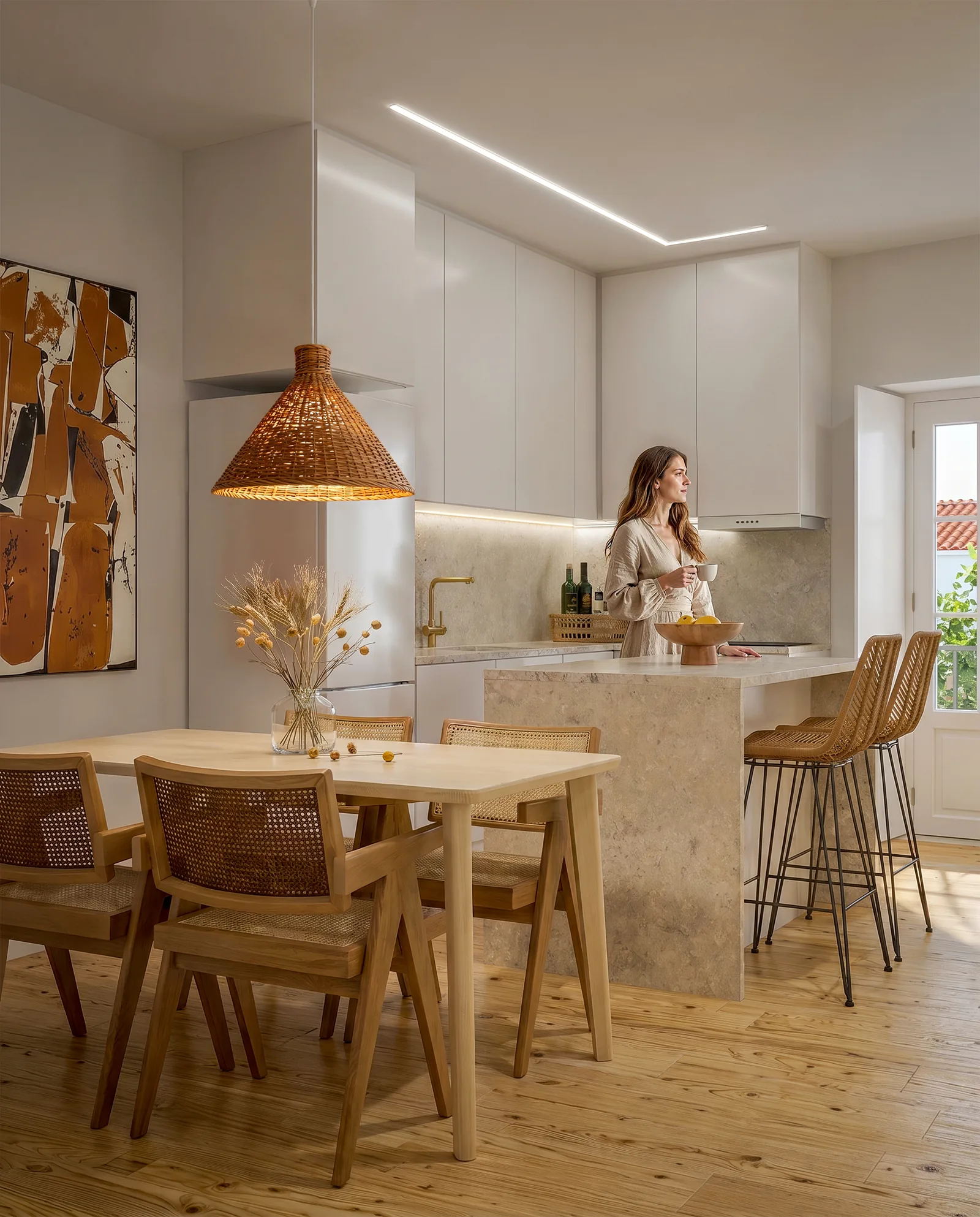
Layer 3. The detail: build desire through the materials
After the overall space, go into the detail.
A close-up of the marble with the lighting revealing its veins. The texture of the oak flooring. Light reflecting off a lacquered surface. The detail of the window frame where inside meets outside.
These posts have a specific role: validating quality before the price is discussed.
When a buyer sees these details in the weeks before the launch, the price is no longer a surprise. They have already understood, visually, why it is worth what it costs.
Detail posts also have a technical advantage: they get a high save rate on Instagram. People save material references. Every save is a signal of interest that the algorithm amplifies.
Layer 4. The narrative: tell the story of the project
This is the most powerful layer, and the most ignored.
Before revealing more images, tell the story behind the project. The neighbourhood and its transformation. The architectural concept and the decisions that shaped it. The lead architect and their vision. The relationship between the interior and its surroundings.
This layer turns a property product into a life project, and life projects do not get dragged into price wars.
A short video of the architect explaining a design decision. A post about the history of the neighbourhood the development sits in. A photograph of the site before work began, with a caption that hints at what will exist there.
The buyer who absorbs this narrative in the weeks before the launch does not arrive as a stranger. They arrive as someone who already knows the project, and has already decided they want to be part of it.
Layer 5. The launch: create urgency with real scarcity
When the launch arrives, you have an audience that has been warming up for weeks.
Now is the time to reveal what was missing: the prices, the unit types available, the reservation process.
And to create urgency: “Reservations open next Thursday. Our pre-registration list gets 48 hours' early access.”
Scarcity, when it is real, is the most powerful decision motivator there is. And an audience that has wanted the project for weeks does not need much to go ahead.
What makes 3D renders for social media different from all the others
There is a difference between a render produced for a brochure and a render produced for social media.
It is not a question of quality; it is a question of format and intent.
Vertical format (9:16): Most content on social media is consumed on a phone, held vertically. A horizontal render loses a third of the screen to white space. A vertical render fills the whole screen and gets a significantly higher engagement rate.
Immediate visual hierarchy: In feeds, you have less than two seconds to stop the scroll. The social-first render has an obvious focal point, something the eye finds instantly, before any conscious reading.
Tactile elements of life: Everyday objects, visible textures, light with temperature, everything that creates the feeling that the space is real and liveable, not a technical demonstration.
Room for overlaid text: In Reels and Stories, text appears over the image. A render with too much visual information at the edges (where the text will go) becomes cluttered. A render with areas of visual “breathing space” accommodates the message better.
The
content timeline for the pre-launch weeksFor a property launch with six weeks' lead time, this is the content timeline that works:
Weeks 5 and 6 before launch: teaser and materials. Detail posts. Nothing of the complete space. Create curiosity without revealing. Goal: gain followers and the first saves.
Weeks 3 and 4 before launch: first render and narrative. The strongest emotional render. The story of the neighbourhood and the concept. A short video of the architect or the process. Goal: create desire and generate pre-registrations.
Weeks 1 and 2 before launch: progressive reveal. More renders by unit type. Specific details of finishes. A subtle countdown. Goal: warm up the list of prospects and create urgency to pre-register.
Launch day: reservations open. Every channel at once. Stories, posts, emails to the list, paid campaigns. Goal: turn the accumulated desire into actual reservations.
The algorithm works for you, if you know how
Social media platforms share one interest: keeping people engaged. And they reward the content that achieves it.
3D renders, when well produced, have naturally high engagement rates, because they are visually rich, they spark curiosity and they respond to the human instinct to imagine possibilities.
But there are specific behaviours that amplify that reach:
Saves. When someone saves a post, it is the strongest signal Instagram's algorithm recognises. Material detail posts and aspirational renders have a high save rate.
Comments with questions. A caption that ends with an open question, “Which would be your favourite space?” or “What could your dream kitchen not do without?”, generates comments that the algorithm amplifies.
Shares. The post someone sends to another person is the one with the greatest organic reach. Emotional renders, the ones that create the “look at this” feeling, are the most shared.
Consistency. Posting regularly in the pre-launch weeks keeps the project in followers' feeds and makes it more likely to be seen at the right moment.
Conclusion
Social media is not where the project goes once it is ready to be sold.
It is where the project starts to be wanted, weeks before it is available to buy.
The 3D render is the only tool that makes this possible before any construction exists. That lets you show the future as if it were the present. That lets you create the desire that turns launch day into an event, instead of an anxious wait for viewings.
Used strategically, in layers, with intent and consistency, 3D on social media is not marketing. It is the first phase of the sale.
And the developers who have understood this are sold out before the others know the project exists.
👉 Preparing a project for launch and want to structure the visual strategy from the start? Talk to us.
Foreseen Projects (formerly Hugo Guerra Design) is a studio specialising in architectural and real estate 3D visualisation, a strategic partner to architects, developers, builders and interior designers in Portugal.